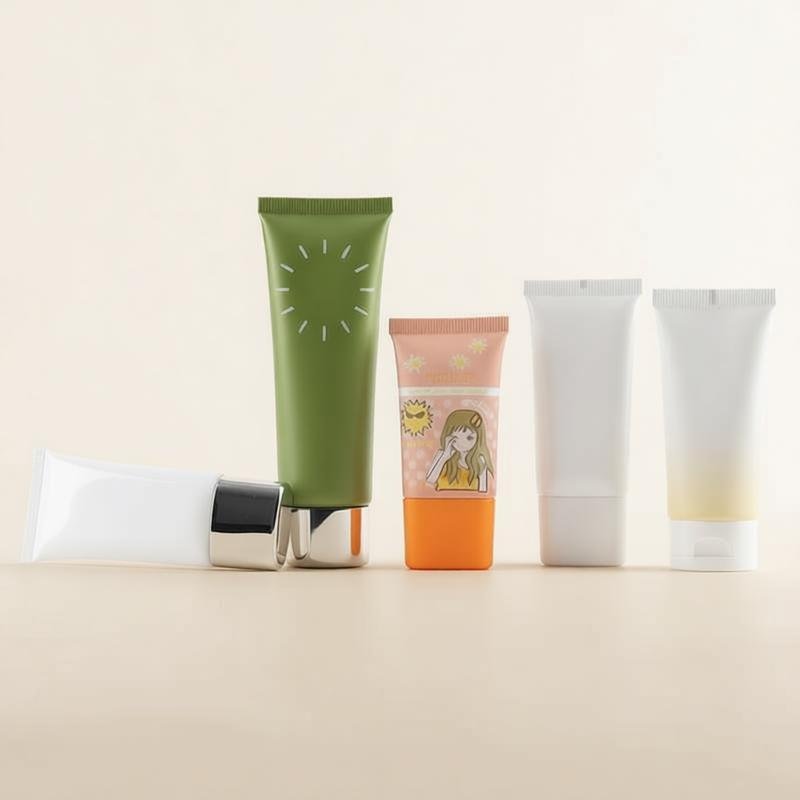
Choosing a “good sunscreen packaging material” hinges on matching the formula characteristics of the sunscreen product, the usage scenarios, and the consumer experience requirements. According to the latest public information in 2026, sunscreen packaging materials must first meet three core indicators: barrier properties, air tightness, and compatibility. 。 The following are the mainstream packaging material types and their applicable scenarios:
I. Mainstream Sunscreen Packaging Types and Characteristics
- Emulsion/Cream Tube
Standard extrusion tube: Low cost and straightforward operation, suitable for daily use of cream or lotion-based sunscreens, and can be used with screw caps or flip caps.
TU30 pointed nozzle tube: Precise dispensing, suitable for high-SPF sunscreens on the face and around the eyes, reducing waste.
Vacuum tube / TU56 vacuum pump head tube: The formula is completely isolated from air throughout the process, suitable for high-end sunscreens containing unstable ingredients (such as vitamin C and retinol), enhancing stability. 。
Hard sunscreen bottle
It features high design freedom, large printing area and strong visual impact, making it suitable for shaping the image of mid-to-high-end brands. It is commonly seen in bottle-packed sunscreen lotions and essence-type sunscreen products. 。
Pump bottle (100ml+)
It has a stable output and is effortless to use, making it suitable for both facial and full-body sun protection. It is a mainstream large-capacity packaging. 。
Innovative forms
Sunscreen Cushion: Solves the problem of reapplication after makeup without disturbing the makeup look.
Sunscreen Powder Compact: With a powder press design, it can be reapplied with a simple press. It is suitable for oily skin and provides matte protection. 。
II. Key Considerations for Selecting Packaging Materials
Formula Compatibility
Physical sunscreens (containing zinc oxide/titanium dioxide) have relatively low requirements for packaging materials; chemical sunscreens (such as avobenzone, octocrylene) are easily affected by light/oxygen, and vacuum or opaque packaging materials are preferred. 。
Usage scenarios
For detailed facial application → Use a fine-tipped nozzle or a small-bore pump bottle;
For full-body use → Use a large-capacity pump bottle or a hose;
For touch-ups after makeup → Use cushion or powder compact packaging. 。
Brand Positioning and Cost
The high-end line offers the option of a vacuum pump and a hard bottle to enhance the texture; the mass-market and affordable line can choose a standard hose or an economical pump bottle to control costs. 。
Sealing and Leak Prevention
For hoses, pay attention to the sealing process at the end (such as cross-pressing patterns); for bottled products, ensure double sealing with the inner stopper and outer cap to prevent leakage during transportation. 。
III. Recommended Packaging Material Suppliers (Support Customization)
If you need to purchase or customize, you can refer to the following professional manufacturers:
Morningsun packaging offers one-stop packaging solutions including tubes, vacuum bottles, cream jars, etc., and supports OEM/ODM. 。
Official website: https://morningsunpackaging.com/